
AI and society /
Robots are about to get weirdly ordinary
Not one silver humanoid doing everything.
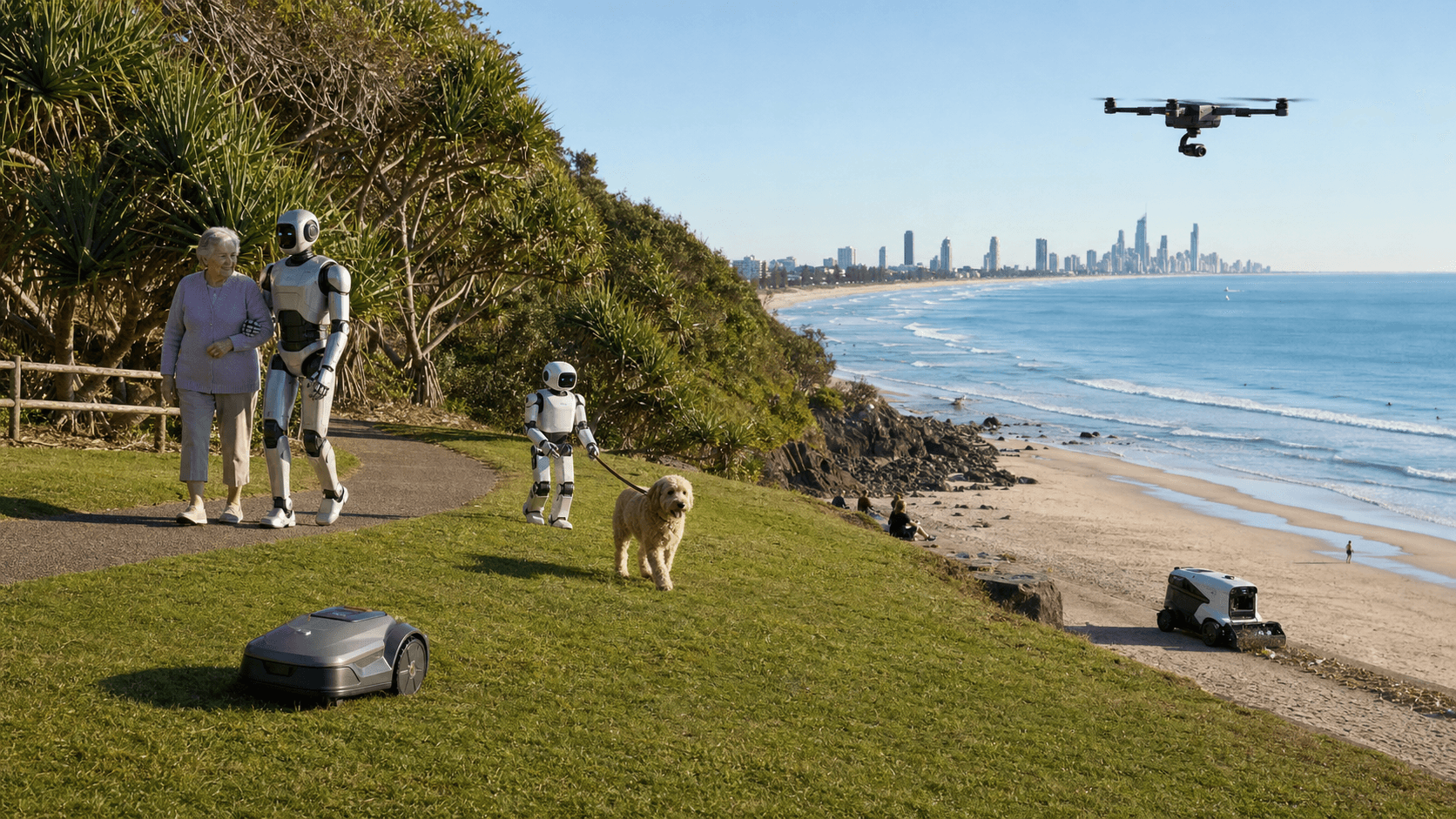
A mower that knows the yard. A drone watching the water for sharks. A machine carrying groceries home. A robot walking beside your parents when they need a steady hand.
Nothing dramatic. They are simply there, doing jobs.
The brain stopped caring about the body
AI changed software because useful intelligence became cheap to copy.
Robotics gets interesting when that intelligence can move between bodies.
Put it behind a camera and rotors and it becomes a beach patrol drone. Give it wheels and blades and it maintains a lawn. Give it legs, hands and depth perception and it can work inside spaces designed for people.
You can call this substrate-independent intelligence. The simpler version is that the brain stops caring what body it lives in.
That is the Cambrian part. Intelligence does not produce one winning robot. It produces an explosion of forms, each shaped around a job and an environment.
Humanoid where stairs, doors and tools were built for humans. Wheels where the ground is flat. Rotors where the useful position is overhead.
The bodies will be different. The intelligence underneath them may come from the same few systems.
Atoms are still hard
Software can fail and reload. A robot has batteries, motors, weather, sand, pets, children and liability.
That matters. Physical reliability will slow this down. Hardware costs money to manufacture, ship, repair and replace.
The mistake is assuming slow hardware progress means slow adoption forever.
Once a robot becomes cheap and reliable enough for one useful job, the decision changes quickly. A mower does not need to understand the whole world. It needs to understand the lawn. A shark-spotting drone does not need hands. It needs good vision, safe flight and a clear escalation path.
Specialisation lowers the bar.
It will not feel like arrival
The first robot in your home may be a vacuum or mower. You will stop thinking of it as a robot within a week.
Then another machine takes one physical job. Then another.
By the time a capable humanoid walks through the front door, the strange part may be how unsurprising it feels.
That is what people miss when they picture one robot in every home. The home may have five before anyone thinks to count them.
The rule
Do not picture one robot arriving.
Picture intelligence spreading into machines that can move.